Do I Need an AI Chatbot for My Business? Five Signs You Do
If you have asked yourself whether you need an AI chatbot for your business, you are probably already spending time on the thing it would take over: answering the same questions, by phone and by email, week after week. The honest answer to "do I need an AI chatbot" depends on what those questions look like, and this post gives you five signs that the answer is yes, two signs that it is not yet, and a test you can run in ten minutes with nothing but your own inbox.
Five signs you need an AI chatbot
The first sign is repetition. If you can name the five questions you answer most often without looking, you have found the work an assistant does best. Prices, opening hours, what is included, how long something takes, whether you cover a particular area: these questions have settled answers, and an assistant built from your own documents gives the same correct answer every time, without you.
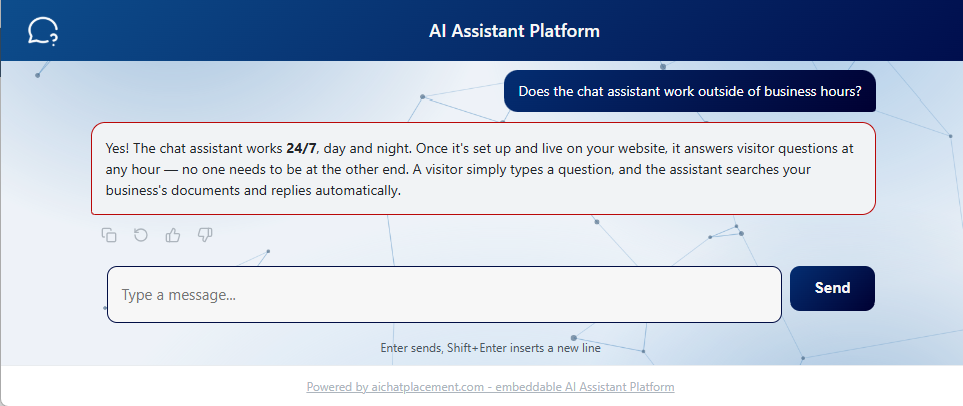
The second sign is timing. Look at when the questions arrive. If a good share of them come in the evening, at the weekend, or during the hours when you are with a customer and cannot answer, then every one of them is a visitor who waited, and some of them did not wait. An assistant answers at once, at any hour, and that is the whole of its advantage over a contact form.
The third sign is that your answers already exist in writing. A price list, a page of frequently asked questions, a service description, a policy document, the same three explanations you paste into email: if this material exists, the assistant can be built from it in an hour. If most of it exists, you are close.
The fourth sign is the visitor who never asks. Most people who have a question do not send it. They look for the answer for a minute, do not find it, and leave for a competitor whose site answered. You will not see these people in your inbox, which is exactly why they are the strongest sign of all. An assistant catches the question at the moment it is asked, in plain language, without a form.
The fifth sign is that the answer changes with the situation. "Are you open now", "do you deliver to my area", "is this size in stock this week": these are questions where a static page struggles and a conversation succeeds, because the visitor can say what their situation is and get the answer that applies to it.
Two signs you do not need one yet
The first is that your questions are genuinely one of a kind. If every enquiry is a custom project that needs a conversation, a site visit and a quotation, an assistant cannot do that part, and it should not pretend to. It can still take the basic questions off your desk, but if there are few of those, the gain is small.
The second is that nothing is written down. An assistant answers only from your documents. If your prices are in your head and your policies are whatever you decided last time, the first job is to write them down, and that job is worth doing whether or not an assistant follows. Once the material exists, the decision usually makes itself.
What an AI chatbot is, and what it is not
An assistant of this kind answers questions from the documents you give it, and only from those. It does not browse the internet, and it does not make things up about your business; when a question falls outside your documents, it says so. That limit is what makes it safe to put in front of customers, and it is also why the quality of the assistant is the quality of your documents.
It is not a salesperson and not a replacement for you. It removes the repetitive part of customer contact so that the conversations you do have are the ones that need you. If you want a comparison with the alternative of a person answering live, we have written one: chatbot or live chat for small business.
A ten-minute test with your own inbox
Open your sent mail for last month and count the replies that answered a question a visitor could have asked on your website. Put each one into one of two piles: answered from something you have written down, or answered from your head. Then count the ones that arrived outside your working hours.
If the first pile is bigger than the second, an assistant can take most of that work today. If the out-of-hours count is more than a handful, it can take work you did not even know you were losing. If both piles are small, you have your answer too, and it cost you ten minutes rather than a subscription.
If the answer is yes
Start with the documents. Gather the ones that answer your five most common questions, and read our guide on which questions to automate first. Then see the process end to end on our how it works page, and try the assistant on our demo page, where it answers questions about the platform from the platform's own documents. When you are ready to compare plans, the pricing page has the details.