Chatbot or Live Chat for Small Business: Which One Do You Actually Need?
If you have been looking into putting a chat window on your website, you have probably come across two things being sold in almost the same words: live chat and chatbots. Choosing between a chatbot or live chat for a small business is easier once you know what each one actually does, because they are not the same thing at all.
What live chat is
Live chat is a chat window on your website with a real person answering behind it. A visitor types a question, a notification appears on someone's screen at your end, and that person reads it and types a reply.

The software itself does very little. It carries the messages back and forth, and that is all. Everything valuable about live chat comes from the person doing the answering, because a person can understand an unusual question, notice when a customer is unhappy, quote for a job that does not fit the standard price list, and make a decision on the spot.
What a chatbot is
A chatbot is the same window with software answering instead of a person. Nobody at your end is notified, because nobody needs to be. The software reads the question and writes the reply itself.
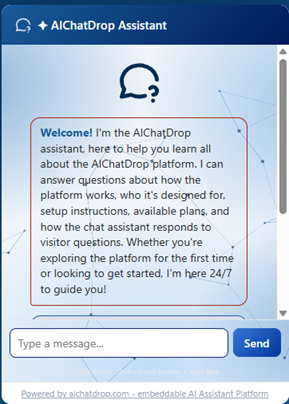
What matters is where its answers come from. A chatbot set up on your own material, such as your price list, your terms, or the questions and answers already on your site, will answer from those documents and nothing else. If a visitor asks what you charge, it gives your prices. If they ask something your documents do not cover, a well built one will say that it does not know rather than make something up.
This is worth saying because many people still picture the chatbots of ten years ago, which offered a few fixed buttons and rarely had the one you wanted. Those are not what is being sold today.
Why the two get compared at all
They get compared because a visitor cannot tell them apart. Both appear as a small window in the corner of the page, both invite you to type a question, and both are advertised under the same phrase. Someone can easily buy one while picturing the other, and only find out months later.
It also helps to know that they are not really rival products. They deal with different halves of the same problem. Live chat is for conversations, and a chatbot is for questions that have the same answer every time somebody asks them.
The question that usually settles it
The deciding factor for most small businesses is simply whether someone can reply within a couple of minutes during the hours your website has visitors.
That has to be true in practice rather than in principle. It is easy to say yes when you are setting things up, and much harder on an ordinary Tuesday when you are out on a job or with a customer in front of you.
If you have a support desk with two or more people on shift, the answer is genuinely yes, and live chat will earn its place. If you are a small team where everyone is already doing several jobs, the honest answer is usually no, and it is better to know that at the start. A live chat window that nobody answers does more harm than no window at all, because the visitor has watched you ignore them.
A chatbot does not have this problem. There is nothing to keep up with, and it answers at nine in the evening exactly as it does at nine in the morning.
What each one is poor at
Live chat struggles with volume and with hours. A small business can easily field forty repeat questions a week, such as whether you take card payments, whether you cover a particular area, or what time you open. Answering those by hand takes a serious slice of the working month, and the answers are already written down somewhere.
A chatbot struggles with anything that calls for judgement. It cannot tell that a customer is upset, it cannot price an unusual job, and it cannot decide that this particular person is worth making an exception for. Asked to do those things, it will give a stiff and unhelpful answer.
The two fail in opposite directions, which is a good sign that they are answering different needs.
What each one costs you
The costs are of different kinds, which is part of why the comparison is awkward.
Live chat costs attention. The software is rarely the expensive part; the expensive part is somebody being ready to answer during the hours your site is busy, and being interrupted whenever a message arrives. That cost is real whether or not anybody types anything that day.
A chatbot costs setting-up time and a monthly fee. The setting-up time is spent gathering your documents and checking the answers, which for most businesses is under an hour. After that it runs without anyone watching it. What you pay each month depends on how many assistants you need, how capable a model you want behind them and how you place the chat on your site, and the pricing page sets out the plans.
Why most small businesses start with the chatbot
A common approach is to put a chatbot on the site first, let it handle the repeat questions, and then read through a few weeks of conversations to see what is left over.
Every conversation is written down for you, with the question, the answer, and whether the visitor rated it up or down. What is left over is the real list of things that need a person, and it is nearly always shorter than expected. Once you can see it, you can decide how those few people should reach you, and you are working from what actually happened rather than from a guess made before anything was running.
Starting the other way round means committing someone's time to a chat window before you know what is going to arrive in it.
Where to start
If you would like to see what setting one up involves, how to add an AI chat assistant to your website goes through it step by step. It takes most people under an hour and does not require a developer.
When you are ready to try it against your own price list and policies, you can create a free account and see how it answers.